
This website uses cookies to ensure you get the best experience on our website.

Learn more
Got it!
Whitefield Primary School Logo
  • [email protected]
  • 0151 263 5976
  • About us
    • Mission Statement
    • Our Team
    • Statutory Website Information
    • Governors
      • Governing Body and Committees
      • Governor Diversity
      • Governor Meeting Attendance
    • Areas of Excellence
    • School Videos
    • Podcasts
    • Communication
    • Vacancies
  • Parents
    • Operation Encompass
    • Dates for Parents
      • School Calendar
      • Term dates
    • All About Early Years
    • Attendance Guide for Parents
    • Admissions
      • Nursery Admissions
      • Primary Admissions
      • Secondary Admissions
    • Complaints
    • Keeping children safe and well
    • School Health Website
    • Zones of Regulation and Behaviour
    • Help with Mental Health
    • eSafety advice for parents
      • Safer Schools App
      • Parent Info from CEOP and Parent Zone
      • Top Tips to keep your child safe online
      • eCadets
      • Safer Internet Centre – Starting Conversations with your children
      • Safer Internet Centre – Advice for parents
      • Useful websites
    • myHappymind
    • Support for Special Educational Needs
      • SEND information report
      • Specific Learning Difficulties
      • Autistic Spectrum Conditions
    • Parent Groups
    • Wraparound After School
    • Breakfast & After School Clubs
      • After School Clubs
      • Lunchtime Clubs
      • Breakfast Club
    • Uniforms
    • School dinners
    • Reading and Phonics
    • Personal, Social and Health Education – Sex and Relationships Education
    • British Values – A guide for parents
    • Surveys
  • Information
    • Statutory
    • Safeguarding
    • Current Vacancies
    • Contact
    • Operation Encompass
    • Financial Information
    • Policies
      • Key Policies
    • Inclusion
      • ADHD Friendly School
      • Inclusion and Equality
      • SEND information report
      • The EHCP process for parents
      • Zones of Regulation and Behaviour
    • Equality
    • UNICEF Rights Respecting School
    • Funding – Pupil / Sport /Catch Up Premium
    • Outstanding Ofsted
    • Results and Performance Tables
    • SMSC and British Values
      • British Values at Whitefield Primary School
      • British Values – A guide for parents
      • Spiritual, Moral, Social and Cultural Education
    • Advice to keep children safe
    • The Prevent Duty
    • Suppliers and Partners
  • Curriculum
    • Curriculum Intent Statement
    • Growth Curriculum
    • Curriculum of Ambition – by subject
    • Early Years
    • Ks1 & KS2 Long Term Plans
  • Pupils
    • I need immediate help?
    • The hub
    • Help with Mental Health
    • Pupil Leadership
      • Children’s Committee
      • Librarians
      • eCadets
      • Play Leaders
    • Special Awards
      • Care Connection Confidence Ambassadors
      • Reading Ambassadors
    • Times Tables Rockstars
    • eSafety Links for Kids
  • Staff
    • Safeguarding Documents
    • Staff Information
    • Growth Curriculum
    • Class Curriculum Sites
Whitefield Primary School Logo
  • About us
    • Mission Statement
    • Our Team
    • Statutory Website Information
    • Governors
      • Governing Body and Committees
      • Governor Diversity
      • Governor Meeting Attendance
    • Areas of Excellence
    • School Videos
    • Podcasts
    • Communication
    • Vacancies
  • Parents
    • Operation Encompass
    • Dates for Parents
      • School Calendar
      • Term dates
    • All About Early Years
    • Attendance Guide for Parents
    • Admissions
      • Nursery Admissions
      • Primary Admissions
      • Secondary Admissions
    • Complaints
    • Keeping children safe and well
    • School Health Website
    • Zones of Regulation and Behaviour
    • Help with Mental Health
    • eSafety advice for parents
      • Safer Schools App
      • Parent Info from CEOP and Parent Zone
      • Top Tips to keep your child safe online
      • eCadets
      • Safer Internet Centre – Starting Conversations with your children
      • Safer Internet Centre – Advice for parents
      • Useful websites
    • myHappymind
    • Support for Special Educational Needs
      • SEND information report
      • Specific Learning Difficulties
      • Autistic Spectrum Conditions
    • Parent Groups
    • Wraparound After School
    • Breakfast & After School Clubs
      • After School Clubs
      • Lunchtime Clubs
      • Breakfast Club
    • Uniforms
    • School dinners
    • Reading and Phonics
    • Personal, Social and Health Education – Sex and Relationships Education
    • British Values – A guide for parents
    • Surveys
  • Information
    • Statutory
    • Safeguarding
    • Current Vacancies
    • Contact
    • Operation Encompass
    • Financial Information
    • Policies
      • Key Policies
    • Inclusion
      • ADHD Friendly School
      • Inclusion and Equality
      • SEND information report
      • The EHCP process for parents
      • Zones of Regulation and Behaviour
    • Equality
    • UNICEF Rights Respecting School
    • Funding – Pupil / Sport /Catch Up Premium
    • Outstanding Ofsted
    • Results and Performance Tables
    • SMSC and British Values
      • British Values at Whitefield Primary School
      • British Values – A guide for parents
      • Spiritual, Moral, Social and Cultural Education
    • Advice to keep children safe
    • The Prevent Duty
    • Suppliers and Partners
  • Curriculum
    • Curriculum Intent Statement
    • Growth Curriculum
    • Curriculum of Ambition – by subject
    • Early Years
    • Ks1 & KS2 Long Term Plans
  • Pupils
    • I need immediate help?
    • The hub
    • Help with Mental Health
    • Pupil Leadership
      • Children’s Committee
      • Librarians
      • eCadets
      • Play Leaders
    • Special Awards
      • Care Connection Confidence Ambassadors
      • Reading Ambassadors
    • Times Tables Rockstars
    • eSafety Links for Kids
  • Staff
    • Safeguarding Documents
    • Staff Information
    • Growth Curriculum
    • Class Curriculum Sites
Whitefield Primary School Logo
  • About us
    • Mission Statement
    • Our Team
    • Statutory Website Information
    • Governors
      • Governing Body and Committees
      • Governor Diversity
      • Governor Meeting Attendance
    • Areas of Excellence
    • School Videos
    • Podcasts
    • Communication
    • Vacancies
  • Parents
    • Operation Encompass
    • Dates for Parents
      • School Calendar
      • Term dates
    • All About Early Years
    • Attendance Guide for Parents
    • Admissions
      • Nursery Admissions
      • Primary Admissions
      • Secondary Admissions
    • Complaints
    • Keeping children safe and well
    • School Health Website
    • Zones of Regulation and Behaviour
    • Help with Mental Health
    • eSafety advice for parents
      • Safer Schools App
      • Parent Info from CEOP and Parent Zone
      • Top Tips to keep your child safe online
      • eCadets
      • Safer Internet Centre – Starting Conversations with your children
      • Safer Internet Centre – Advice for parents
      • Useful websites
    • myHappymind
    • Support for Special Educational Needs
      • SEND information report
      • Specific Learning Difficulties
      • Autistic Spectrum Conditions
    • Parent Groups
    • Wraparound After School
    • Breakfast & After School Clubs
      • After School Clubs
      • Lunchtime Clubs
      • Breakfast Club
    • Uniforms
    • School dinners
    • Reading and Phonics
    • Personal, Social and Health Education – Sex and Relationships Education
    • British Values – A guide for parents
    • Surveys
  • Information
    • Statutory
    • Safeguarding
    • Current Vacancies
    • Contact
    • Operation Encompass
    • Financial Information
    • Policies
      • Key Policies
    • Inclusion
      • ADHD Friendly School
      • Inclusion and Equality
      • SEND information report
      • The EHCP process for parents
      • Zones of Regulation and Behaviour
    • Equality
    • UNICEF Rights Respecting School
    • Funding – Pupil / Sport /Catch Up Premium
    • Outstanding Ofsted
    • Results and Performance Tables
    • SMSC and British Values
      • British Values at Whitefield Primary School
      • British Values – A guide for parents
      • Spiritual, Moral, Social and Cultural Education
    • Advice to keep children safe
    • The Prevent Duty
    • Suppliers and Partners
  • Curriculum
    • Curriculum Intent Statement
    • Growth Curriculum
    • Curriculum of Ambition – by subject
    • Early Years
    • Ks1 & KS2 Long Term Plans
  • Pupils
    • I need immediate help?
    • The hub
    • Help with Mental Health
    • Pupil Leadership
      • Children’s Committee
      • Librarians
      • eCadets
      • Play Leaders
    • Special Awards
      • Care Connection Confidence Ambassadors
      • Reading Ambassadors
    • Times Tables Rockstars
    • eSafety Links for Kids
  • Staff
    • Safeguarding Documents
    • Staff Information
    • Growth Curriculum
    • Class Curriculum Sites
  • [email protected]
  • 0151 263 5976

Geography

Intent, Implementation and Impact


Subject Overview


At Whitefield we are currently moving to use CUSP Geography.

This draws upon several powerful sources of knowledge. It is our intention that pupils become a little more expert as they progress through the curriculum, accumulating and connecting substantive and disciplinary geographical knowledge.

a) Substantive knowledge – this is the subject knowledge and explicit vocabulary used to learn about the content. Common misconceptions are explicitly revealed as non-examples and positioned against known and accurate content as pupils become more expert in their understanding. Misconceptions are challenged carefully and in the context of the substantive and disciplinary knowledge.

In CUSP Geography, it is recommended that misconceptions are not introduced too early, as pupils need to construct a mental model in which to position new knowledge.

b) Disciplinary knowledge – this is the use of knowledge and how children become a little more expert as a geographer by Thinking Geographically.

c) Geographical analysis is developed through selecting, organising and integrating knowledge through reasoning and making sense of the content in response to structured questions and well-designed tasks that cause children to think hard as geographers.

d) Substantive concepts are the big ideas, and the golden threads, that run through a coherent and cohesive geography curriculum. They can include place, space, scale, interdependence, physical and human processes, environmental impact, sustainable development, cultural awareness and cultural diversity. Concepts such as change through erosion are taught through explicit vocabulary instruction as well as through the direct content and context of the study.
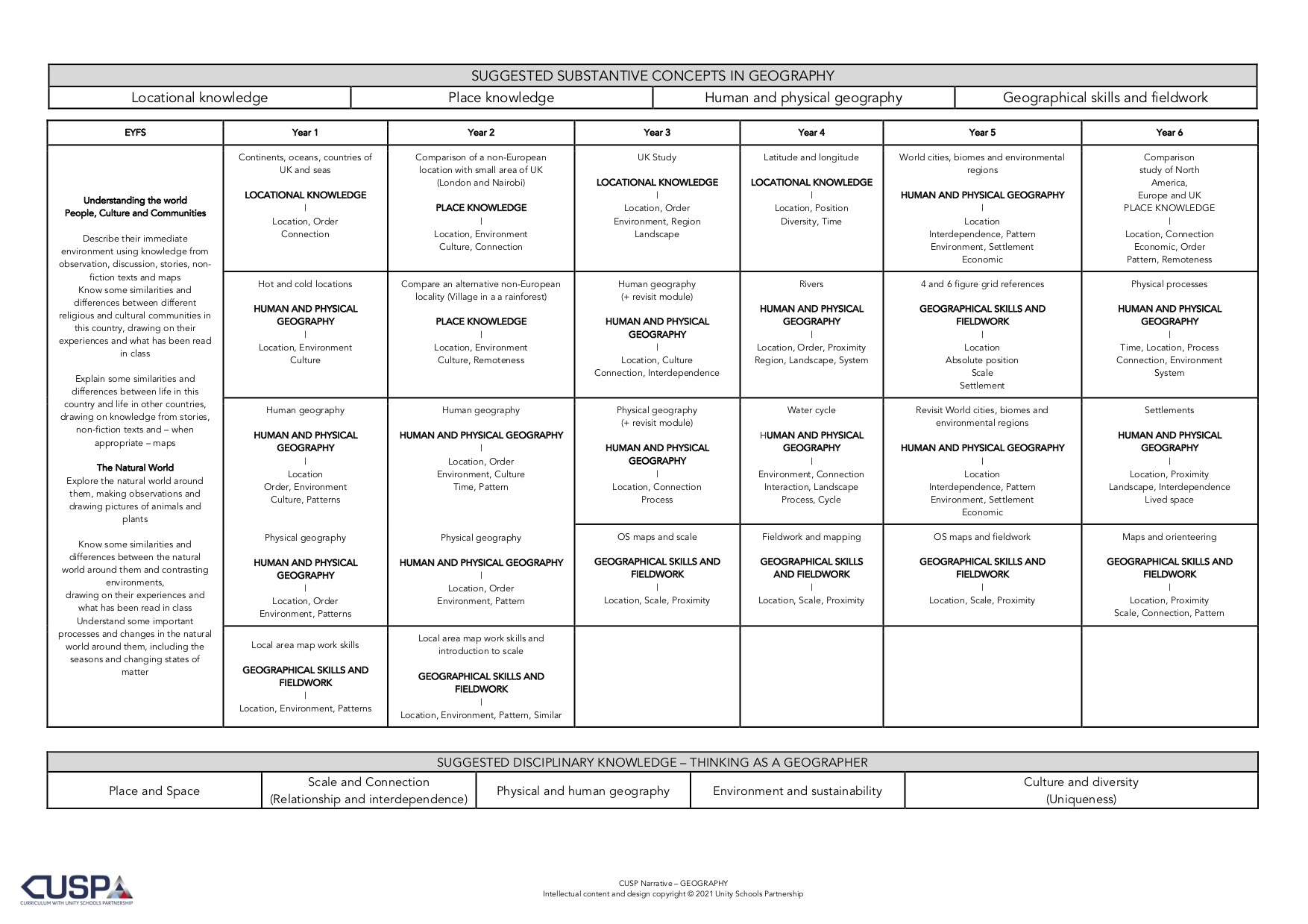
Geography programmes of study: Key Stages 1 and 2

Purpose of study

A high-quality geography education should inspire in pupils a curiosity and fascination about the world and its people that will remain with them for the rest of their lives. Teaching should equip pupils with knowledge about diverse places, people, resources and natural and human environments, together with a deep understanding of the Earth’s key physical and human processes. As pupils progress, their growing knowledge about the world should help them to deepen their understanding of the interaction between physical and human processes, and of the formation and use of landscapes and environments. Geographical knowledge, understanding and skills provide the frameworks and approaches that explain how the Earth’s features at different scales are shaped, interconnected and change over time.

Aims

The national curriculum for geography aims to ensure that all pupils:

  • develop contextual knowledge of the location of globally significant places – both terrestrial and marine – including their defining physical and human characteristics and how these provide a geographical context for understanding the actions of processes
  • understand the processes that give rise to key physical and human geographical features of the world, how these are interdependent and how they bring about spatial variation and change over time
  • are competent in the geographical skills needed to:
    • collect, analyse and communicate with a range of data gathered through experiences of fieldwork that deepen their understanding of geographical processes
    • interpret a range of sources of geographical information, including maps, diagrams, globes, aerial photographs and Geographical Information Systems (GIS)
    • communicate geographical information in a variety of ways, including through maps, numerical and quantitative skills and writing at length.

Attainment targets

By the end of each key stage, pupils are expected to know, apply and understand the matters, skills and processes specified in the relevant programme of study.

Subject content – Key stage 1

Pupils should develop knowledge about the world, the United Kingdom and their locality. They should understand basic subject-specific vocabulary relating to human and physical geography and begin to use geographical skills, including first-hand observation, to enhance their locational awareness.

Pupils should be taught to:

Locational knowledge

  • name and locate the world’s seven continents and five oceans
  • name, locate and identify characteristics of the four countries and capital cities of the United Kingdom and its surrounding seas

Place knowledge

  • understand geographical similarities and differences through studying the human and physical geography of a small area of the United Kingdom, and of a small area in a contrasting non-European country

Human and physical geography

  • identify seasonal and daily weather patterns in the United Kingdom and the location of hot and cold areas of the world in relation to the Equator and the North and South Poles
  • use basic geographical vocabulary to refer to:
    • key physical features, including: beach, cliff, coast, forest, hill, mountain, sea, ocean, river, soil, valley, vegetation, season and weather
    • key human features, including: city, town, village, factory, farm, house, office, port, harbour and shop

Geographical skills and fieldwork

  • use world maps, atlases and globes to identify the United Kingdom and its countries, as well as the countries, continents and oceans studied at this key stage
  • use simple compass directions (North, South, East and West) and locational and directional language [for example, near and far; left and right], to describe the location of features and routes on a map
  • use aerial photographs and plan perspectives to recognise landmarks and basic human and physical features; devise a simple map; and use and construct basic symbols in a key
  • use simple fieldwork and observational skills to study the geography of their school and its grounds and the key human and physical features of its surrounding environment.

Subject Content – Key Stage 2

Pupils should extend their knowledge and understanding beyond the local area to include the United Kingdom and Europe, North and South America. This will include the location and characteristics of a range of the world’s most significant human and physical features. They should develop their use of geographical knowledge, understanding and skills to enhance their locational and place knowledge.

Pupils should be taught to:

Locational knowledge

  • locate the world’s countries, using maps to focus on Europe (including the location of Russia) and North and South America, concentrating on their environmental regions, key physical and human characteristics, countries, and major cities
  • name and locate counties and cities of the United Kingdom, geographical regions and their identifying human and physical characteristics, key topographical features (including hills, mountains, coasts and rivers), and land-use patterns; and understand how some of these aspects have changed over time
  • identify the position and significance of latitude, longitude, Equator, Northern Hemisphere, Southern Hemisphere, the Tropics of Cancer and Capricorn, Arctic and Antarctic Circle, the Prime/Greenwich Meridian and time zones (including day and night)

Place knowledge

  • understand geographical similarities and differences through the study of human and physical geography of a region of the United Kingdom, a region in a European country, and a region within North or South America

Human and physical geography

  • describe and understand key aspects of:
  • physical geography, including: climate zones, biomes and vegetation belts, rivers, mountains, volcanoes and earthquakes, and the water cycle
  • human geography, including: types of settlement and land use, economic activity including trade links, and the distribution of natural resources including energy, food, minerals and water

Geographical skills and fieldwork

  • use maps, atlases, globes and digital/computer mapping to locate countries and describe features studied
  • use the eight points of a compass, four and six-figure grid references, symbols and key (including the use of Ordnance Survey maps) to build their knowledge of the United Kingdom and the wider world
  • use fieldwork to observe, measure, record and present the human and physical features in the local area using a range of methods, including sketch maps, plans and graphs, and digital technologies

Useful Resources


http://www.bbc.co.uk/schools/websites/4_11/site/geography.shtml


Calendar

View more

Contact

Boundary Lane, Liverpool
Merseyside, L6 2HZ

0151 263 5976

[email protected]

Useful Links

  • I need immediate help
  • Term Dates
  • Ofsted

On this website we use first or third-party tools that store small files (cookie) on your device. Cookies are normally used to allow the site to run properly (technical cookies), to generate navigation usage reports (statistics cookies) and to suitable advertise our services/products (profiling cookies). We can directly use technical cookies, but you have the right to choose whether or not to enable statistical and profiling cookies. Enabling these cookies, you help us to offer you a better experience.

Link to our Cookie Policy Page.

School website powered by Realsmart Logo